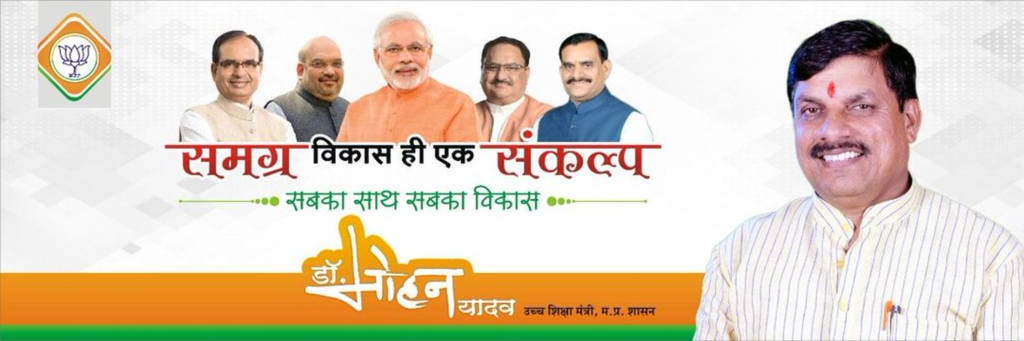
On 11 Dec 2023, Mohan Yadav, MLA from Ujjain Dakshin was designated as the Chief Minister of Madhya Pradesh replacing Shivraj Singh Chouhan. The decision was taken in a meeting between elected BJP MLAs of the state and central party observers.
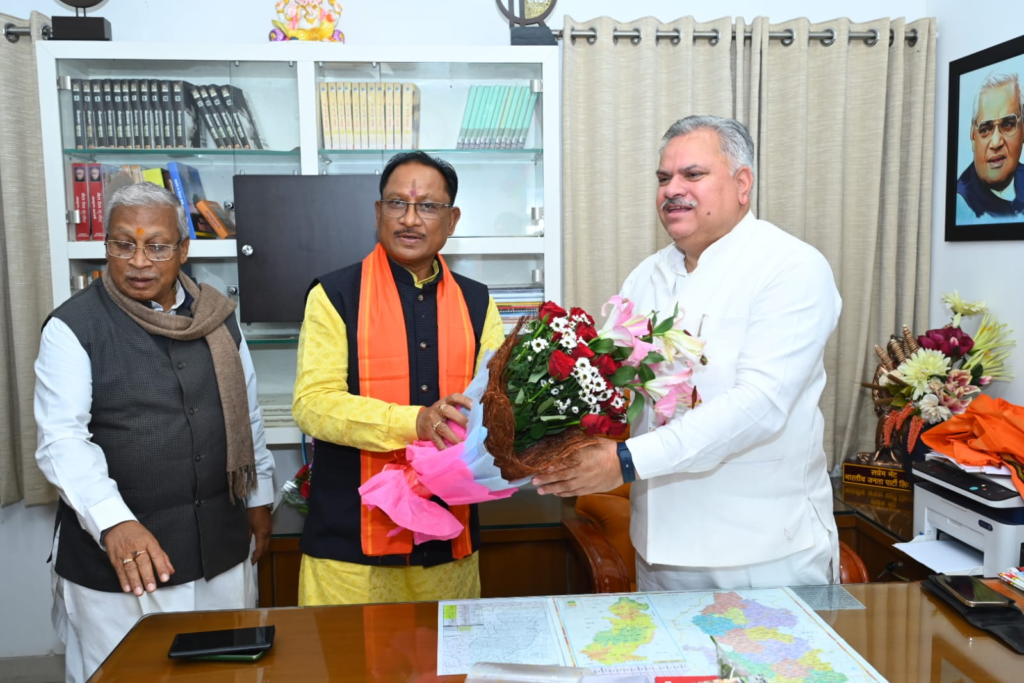
This decision was made a day after Vishnu Deo Sai became the CM of Chhattisgarh.
It is a tradition in Indian politics that if a sitting CM does not continue even when the party gets re-elected, they are given a central leadership role, preferably as a Union Minister.
Possible Ministries for Shivraj Singh Chouhan
The designation of an ex-CM as Union Minister had happened after Assam CM Sarbananda Sonowal got his party re-elected in the 2021 Assam Assembly Elections. Later, Hemanta Biswa Sarma became the CM and Sonowal was sworn in as a Union Minister.
We might witness the a Union Ministry role for Shivraj Singh Chauhan with my experience indicating a heavier ministry such as:
Ministry of AYUSH
Ministry of Communication
Ministry of Electronics and Information Technology
Mohan Yadav who was the former Higher Education Ministry in the Shivraj Singh’s government in Madhya Pradesh has been selected as the Chief Minister in a meeting of party members and elected BJP MLAs of Madhya Pradesh. He won the 2023 Madhya Pradesh Assembly Elections from Ujjain Dakshin for the third time.
His designation as the Chief Minister by the BJP marks the end of 18 years of Shivraj Singh Chauhan who is fondly called as “mama” in the state.
The decision comes after Vishnu Deo Sai was designated as Chhattisgarh CM.
Who is Mohan Yadav? कौन हैं मोहन यादव?
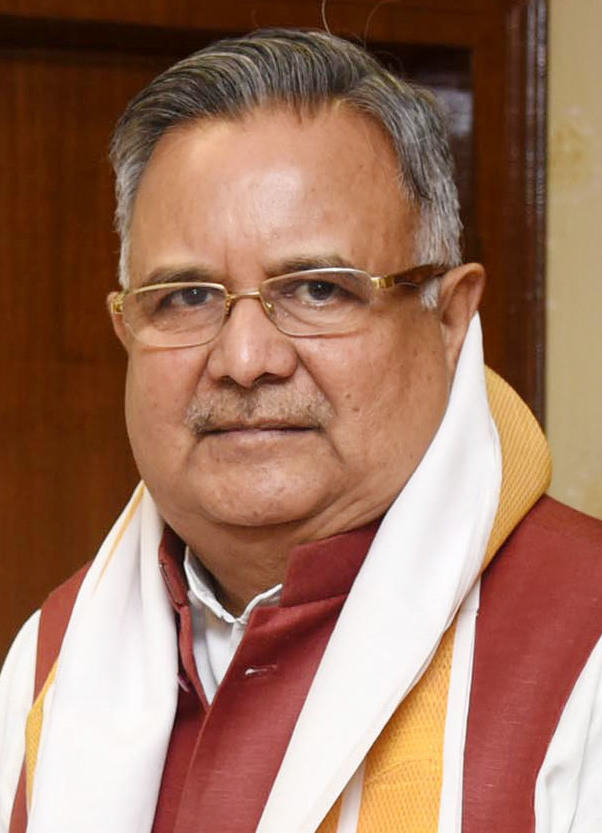
Madhya Pradesh CM Dr. Mohan Yadav
Mohan Yadav has been designated as the CM of Madhya Pradesh after the 2023 Madhya Pradesh Assembly Elections. Earlier in the previous govt (2018-2023), he was the Higher Education Minister in the cabinet of Shivraj Singh Chauhan.
Yadav is 58 years old and has won thrice from the Ujjain Dakshin seat.
He was born on March 25, 1965 to Poonamchand Yadav. He is married to Seema Yadav and has one son.
Yadav has zero criminal cases pending against him, neither he has been convicted in the past.
In his electoral affidavit he has confirmed that he owns a 12 bore gun and a revolver.
Yadav has also headed wrestling associations in the past.
Election History
Mohan Yadav stared his career as an MLA in the 2013 Madhya Pradesh Assembly Elections where he won from Ujjain Dakshin assembly constituency. His number of votes in Ujjain Dakshin constituency has seen a consistent rise since 2013.
He was declared Chief Minister in the BJP meeting between elected MLAs of the party in Madhya Pradesh and observers sent by the party.
The Supreme Court has decides unanimously that the amendment of the Article 360 by the Narendra Modi-led NDA Government in the Indian Parliament on 5-6 Aug 2019 was valid.
Article 370 was amended by the Indian Parliament on Aug 05, 2019 to remove all the special powers given to the state of Jammu and Kashmir.
Summary of the Judgement
Power of President to remove Article 370 Valid
President did not need anyone’s recommendationswhether State Assembly or Union Govt
Elections to be conducted at the earliest and before 30 Sept 2024.
Article 370 was temporary provision based on its reading and its historical context.
It served two interim arrangements
to run the state till the constitution is formed
and due to the war scenario
Setup of commission to study human rights violations by the state and non-state elements in the Jammu and Kashmir.
“We have held that Article 370 is a temporary provision on a reading of the historical context on the basis of which it was included. Article 370 was introduced to serve two purposes.
First, the transitional purpose, to provide for an interim arrangement until the constituent assembly of the state was formed and could take a decision on the legislative competence of the Union (Central Govt) on matters other than the ones stipulated in the Instrument of Accession and ratify the constitution.
And second, a temporary purpose and interim arrangement in view of the special circumstances because of the war conditions in the state.
We have held that a textual reading of the Article 370 also indicates that it is a temporary provision. For this purpose we have referred to the placement of the provision in the Part 21 of The Indian Constitution which deals with Temporary and Transitional Positions. The marginal note to the provision which states temporary provision with respect to the state of Jammu and Kashmir and a reading of Article 370 and 371 by which the state became an integral part of India upon the adoption of the constitution.
Human Rights Violations
Justice SK Kaul said that there will be a commission which will study the human rights violations in the state by anyone whether state or non-state actors since 1980.
Response
PM Narendra Modi
The Prime Minister Modi responded by saying that the Supreme Court decision on Article 370 is a constitutional stamp of approval on the decisions taken by Indian Parliament in 2019.
The PM also said that the current government strives to fulfil the dreams of Jammu, Kashmir and Ladakh with prosperity and developmental works.
Today’s decision as per him was not only a judicial validation but also a ray of hope for a brighter future.
What was the Article 370 Before and After Amendment
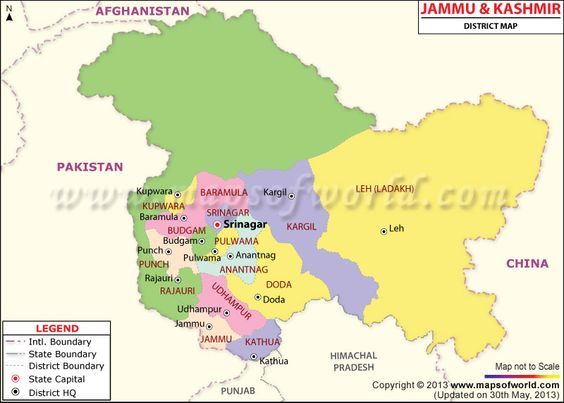
State Map of Jammu and Kashmir before Article 370 Removal and Bifurcation in 2019
370. Temporary provisions with respect to the State of Jammu and Kashmir.
(1) Notwithstanding anything in this Constitution
(a) the provisions of article 238 shall not apply in relation to the State of Jammu and Kashmir;
(b) the power of Parliament to make laws for the said State shall be limited to
(i) those matters in the Union List and the Concurrent List which, in consultation with the Government of the State, are declared by the President to correspond to matters specified in the Instrument of Accession governing the accession of the State to the Dominion of India as the matters with respect to which the Dominion Legislature may make laws for that State; and
(ii) such other matters in the said Lists as, with the concurrence of the Government of the State, the President may by order specify.
(c) the provisions of article 1 and of this article shall apply in relation to that State;
(d) such of the other provisions of this Constitution shall apply in relation to that State subject to such exceptions and modifications as the President may by order specify:
Provided that no such order which relates to the matters specified in the Instrument of Accession of the State referred to in paragraph (i) of sub-clause (b) shall be issued except in consultation with the Government of the State:
Provided further that no such order which relates to matters other than those referred to in the last preceding proviso shall be issued except with the concurrence of that Government.
(2) If the concurrence of the Government of the State referred to in paragraph (ii) of sub-clause (b) of clause (1) or in the second proviso to sub-clause (d) of that clause be given before the Constituent Assembly for the purpose of framing the Constitution of the State is convened, it shall be placed before such Assembly for such decision as it may take thereon.
(3) Notwithstanding anything in the foregoing provisions of this article, the President may, by public notification, declare that this article shall cease to be operative or shall be operative only with such exceptions and modifications and from such date as he may specify:
Provided that the recommendation of the Constituent Assembly of the State referred to in clause (2) shall be necessary before the President issues such a notification.
Article 370 Bare Act After Amendment
All provisions of this Constitution, as amended from time to time, without any modifications or exceptions, shall apply to the State of Jammu and Kashmir notwithstanding anything contrary contained in article 152 or article 308 or any other article of this Constitution or any other provision of the Constitution of Jammu and Kashmir or any law, document, judgment, ordinance, order, by-law, rule, regulation, notification, custom or usage having the force of law in the territory of India, or any other instrument, treaty or agreement as envisaged under article 363 or otherwise.
How was the Amendment Carried Out?
For purposes of the Article 370, the Governor which earlier meant “Sadr-i-Riyasat” (Maharaja of Jammu and Kashmir) as the chief was to be referred as the Governor.
For the purposes of the Article 370, the Constituent Assembly was to be read as the “(Jammu and Kashmir) Legislative Assembly”.
Since the assembly was dissolved as on 5 Aug 2019 – till date, the powers of the assembly was conferred to the Indian Parliament which would be capable of making decisions on behalf of the state as per.
What are Temporary, Transitional and Special Provisions in the Indian Constitution
The articles 369-392 are the Temporary, Transitional and Special provisions of the Indian Constitution which deals with the states of:
Jammu Kashmir – Article 370
Maharashtra and Gujrat – Article 371
Nagaland – Article 371A
Assam – Article 371B
Manipur – Article 371C
Andhra Pradesh – Article 371D, Article 371E and Article 378A
Sikkim – Article 371F
Mizoram – Article 371G
Arunanchal Pradesh – Article 371H
Goa – Article 371I
Karnataka – Article 371J
Article 372 states that laws in the states shall continue in existence.
Article 372A gives powers to the President to adapt laws.
Article 373 gives power to the President to make orders in respect to people under Preventive Detention in Certain Cases.
Article 374 allows judges of the Federal Court (Supreme Court) and proceedings pending in the Federal Court and before His Majesty.
Article 375 deals with continuation of courts, authorities and officers subject to the provisions of Indian Constitution.
Article 376 deals with the provisions of the Judges of the High Courts.
Article 377 deals with the provisions related to the Comptroller and Auditor General.
Article 378 deals with the provisions relating to the Public Service Commissions.
Article 378A deals with the special provisions related to the duration of the Andhra Pradesh Legislative Council (State Assembly).
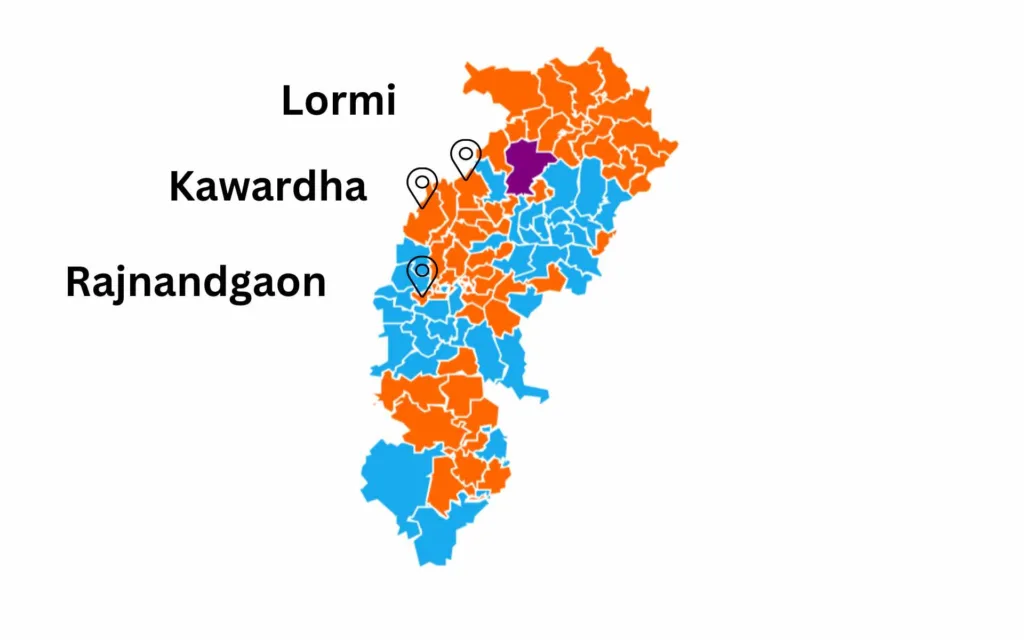
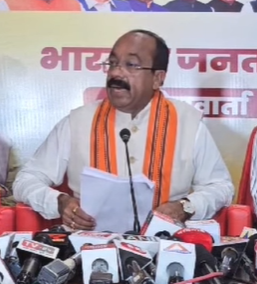
After the selection of Vishnu Deo Sai as Chhattisgarh’s new Chief Minister, the former Chief Minister Dr. Raman Singh gets the designation of speaker in the Chhattisgarh Assembly while former MP Arun Sao and Vijay Sharma get the posts of Deputy Chief Ministers in the state.
Deputy Chief Ministers are not constitutional designations and do not carry any special powers. However, traditionally they are allocated core ministries such as finance, revenue or home.
Dr. Raman Singh won the 2023 Assembly Elections from the Rajnandgaon assembly constituency with a margin of 45,084 votes.
Arun Sao won from the Lormi constituency with a margin of 45,891 votes. He was earlier the MP from Bilaspur which also includes Lormi. Sao had specifically resigned from Lok Sabha on 6 Dec 2023 after winning the 2023 Assembly Elections.
Vijay Sharma won with 39,592 votes from the Kawardha assembly constituency.
The designation of Deputy CM is not a constitutional post but has been used as a consolation prize to accommodate the ambitions of senior leaders who could not be the Chief Minister.
Article 164 of the Indian Constitution says the Chief Minister shall be appointed by the Governor and other ministers shall be appointed by the Governor based on the advice of the Chief Minister.
There is no mention of a Deputy Chief Minister or even a Deputy Prime Minister (last appointee Lal Krishna Advani).
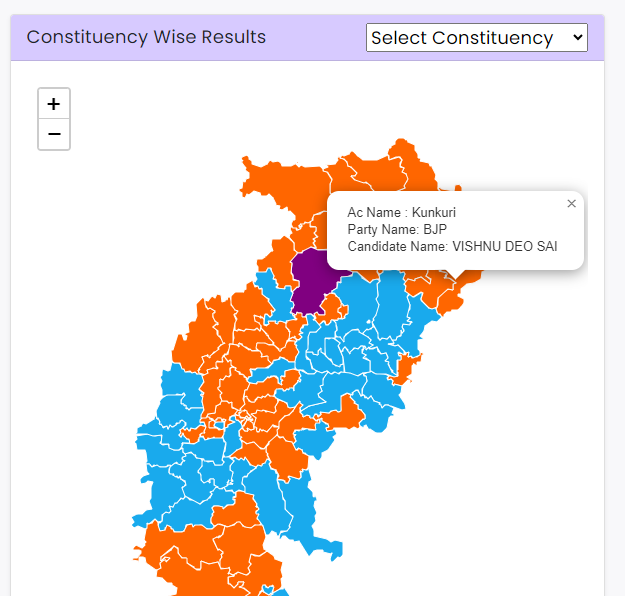
BJP names Vishnu Deo Sai as the Chief Minister of Chhattisgarh on 10 Dec 2023, about 7 days after the party won assembly elections in the state winning 54 out of the 90 seats. Dr Raman Singh was appointed as Assembly Speaker, Arun Sao and Vijay Sharma were designated as Deputy CM.
Union Minister Sarbananda Sonowal, Arjun Minda and Dushyant Gautam were sent by the central party leadership as observers for Chhattisgarh.
The name was finalized after the elected BJP MLAs had a meeting with the observers sent by the party leadership of JP Nadda, PM Modi and Home Minister Amit Shah.
Gopal Bhar (also spelled as Bhand, Bhanr and Bhad) is the famous character in a series of folk tales which show him as the witty court official of the Nadia Zamindar Maharaja Krishna Chandra Roy.
His full name was Gopal Chandra Pramanik Ghumi.
Though his stories seem much similar to Tenali Rama and Birbal, yet the existence of such a court official could
Historical Records of Gopal Bhar
There has been no historical records of Gopal Bhar in the books and magazines that I read so far for the contemporary period.
The Role of Zamindars in Bengal (1707-1772), February 1973, Shirin Akhtar, School of Oriental and African Studies, University of London.
The Calcutta Review: 1872, The Territorial Aristocracy of Bengal – The Nadia Raj
Though there has been several mentions for Maharaja Krishnna Chandra Ray, yet there seems to be no mention of Gopal Bhar.
Krishna Chandra Ray was the maharaja or zamindar of Nadia Zamindari (now Krishnanagar, Nadia District, W.B.) from 1728 – 1782 (see page 67-68). The raja was known for his resistance against the Mughal Rule and expansion of his ancestral Nadia zamindari through purchase of lands or by the use of force.
Area Under Control
Maharaja Krishna Chandra Ray’s area under control included 84 parganas and the area extended to 3151 square miles (approx. 8161 sq. km.) which is similar in size to the current day Indian State of Goa.. The boundaries of his realm was bounded in the north by Murshiadabad, the coastline of the Bay of Bengal by the south, Dhulpura in the east and by the Bhagirathi River on the west.
I have sourced the above information from the book “The Territorial Aristocracy of Bengal: The Nadia Raj“, which was referenced by the Role of the Zamindars in Bengal (1707-1772), report by Shirin Akhtar, Department of Philosophy, The University of London.
Krishna Chandra Ray in The Battle of Plassey
Krishna Chandra Ray is believed to be a part of the group which led to the defeat of Siraj ud Daulah, the Nawab of Bengal in the battle of Plassey (also known as Palashi). The group consisted of the following members:
Jagat Seth
Mir Jafar
Omichand
Rai Durlabh
The battle of Plassey (Palashi) is considered as a key battle that led to the establishment of British Raj in India.
Krishna Chandra Ray in Popular Culture
Maharaja Krishna Chandra Ray is the same king in the Gopal Bhar Stories, a popular folk tale series where Gopal Bhar is a witty official in the court of King Krishna Chandra Ray.
Though historicity of the stories could be disputed in the same regard as Akbar-Birbal. The only original story of the nature is known to be of Tenali Rama who actually was a court official in the court of Emperor Krishnadevaraya of the Vijayanagar Empire.
Sony Aath’s Gopal Bhar
The stories were further popularized with Sony Aath’s animated show “Gopal Bhar”.
Gopal Bhar Movie by Amal Sur Starring Santosh Dutta
The movie Gopal Bhar released on 17 April 1980 was a Bangla movie starred by Santosh Dutta, Robi Ghosh, Tarun Kumar, Asit Baran and others. The movie was directed by Amal Sur.
Santosh Dutta who played the role of Gopal Bhar was also a criminal lawyer and had a delicate balance between his acting and criminal cases often staying late in the night to study his cases before court appearance.
Narendra Modi remains the top global leader with the highest percentage of approval ratings according to a study done by Morningconsult.com. The top 5 leaders in the list were Modi (India), Obrador(Mexico), Alan Berset (Switzerland), da Silva (Brazil) and Albanese (Australia). Joe Biden received a distant 8th spot with 37% approval ratings.
Report by Morning Consult
Morning Consult conducted a survey of national leaders of 22 countries. In the list PM Modi had the highest percentage of approval ratings of 76% followed by Mexico’s President Obrador (66%) and Swiss President Berset (58%).
Other global leaders such as Joe Biden received 37% approval ratings, Rishi Sunak (UK PM) received just 25% ratings, and the Japanese PM Kishida received a mere16% ratings.
Below is the full list as tweeted by Morning Consult.
Modi remains a top choice as a leader in India with several ratings giving him at least 50% of approvals. Even during the COVID, Modi’s approval ratings were 63% as per a report from May 2021 by the same Morning Consult which did the current survey.
Demonetization
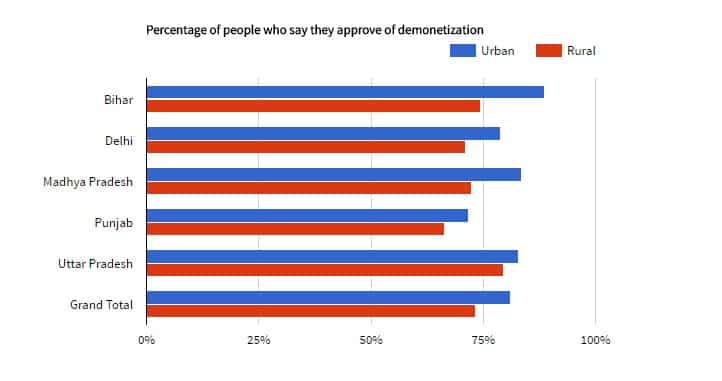
In December 2016, a couple of months after demonetization, PM Modi’s approval ratings were at a high of 75%+ in a survey conducted by Cashless Chronicles. During that time the government gave people 50 days to dispose all the currency notes that were demonetized.
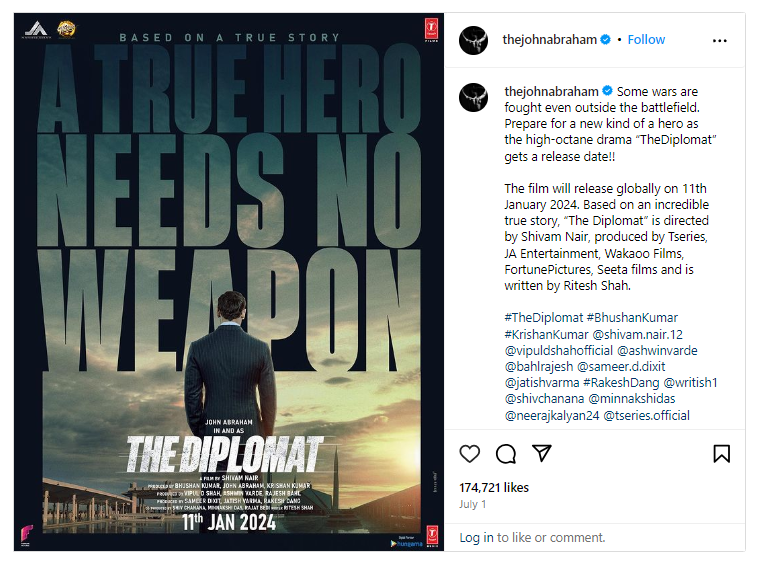
The Diplomat (2024) is an action movie starring John Abraham and directed by Shivam Nair. The movie is set to release on 11 Jan 2024 and features John as a high ranking Indian Diplomat.
It is written by Ritesh Shah.
The movie has being produced by T-Series, Bhushan Kumar and Krishan Kumar, JA Entertainment, Vipul D Shah, Wakaoo Films, Fortune Pictures and Seeta Films.
Poster of Dipomat (2024) movie shared by John Abraham on Instagram.
Storyline
Diplomat features John Abraham as a Indian diplomat.
Cast
Actor
As
John Abraham
Trailer
The trailer shows a high action and explosive first look. The movie is supposedly based on a true story.
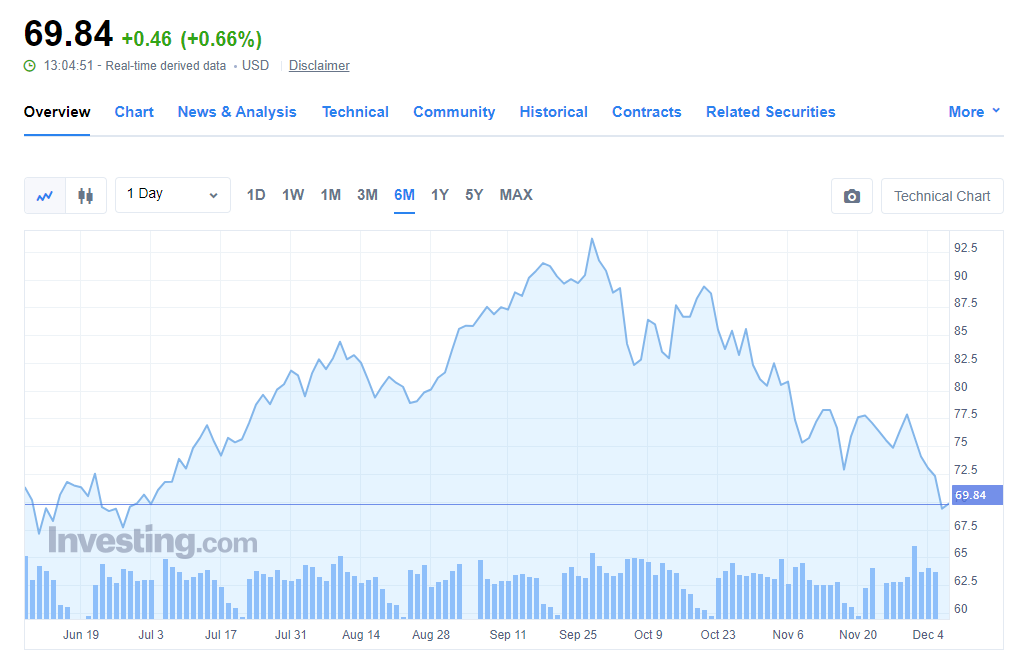
On 7 Dec 2023, the global crude oil prices fell to a 5 month low after concerns of low demand in the market. This news comes when Saudi Arabia has already committed to cut oil productions by 1 million barrels per day on 30 November 2023, followed by a 500k barrels per day cut by Russia. Saudis have also cut the price of oil for their Asian customers in a bid to drive demand.
WTI Crude Oil Prices om 07 December 2023
Low Demand is the Main Factor Driving Oil Prices Down
The global demand for oil has been falling on the back of weakening economies. Several European nations are on the brink of a technical recession. In Q3 of 2023, Euro Zone witnessed a negative growth of -0.1%.
There has been a reduction in the business activity, industrial output which were caused due to rising interest rates and attempts to reduce inflation.
In August 2023, Indian crude oil imports too slid to a 10-month low.
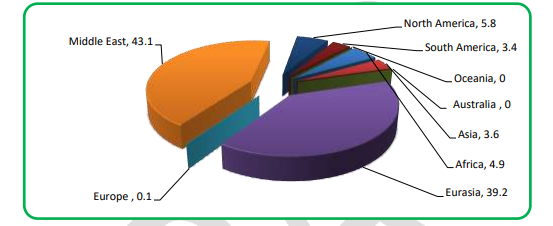
Sources of Indian Crude Oil Imports
Indian Crude Oil Imports April- Aug 2023, Source: ppac.gov.in
Indian reliance on the middle east decreased on the wake of Russia-Ukraine war when global sanctions forced Russian oil and natural gas out of the European markets. This forced Russia to offer crude oil to countries with as deep as 30% discount on the global price.
This is when Indian crude oil imports stareted to increase from Russia.
Is it Good for India?
Oil-based fuels like petrol, diesel, aviation fuel, etc., are the primary energy sources for almost all kinds of road-based transportation in India. A low oil price would mean lesser transportation costs which would further help in reducing the price of transported goods.
Since more than 80% of India’s demand for oil is met via imports, a decline in prices would mean cheaper imports and greater revenue for the states and Union governments.